The Charyn Canyon National Natural Park was founded in 2004 on the territory of 93,150 hectares of the Ili intermountain depression, and in 2009 it was expanded to 127,050 hectares. In 2018, the International Council of the UNESCO Man and the Biosphere Program included the Charyn Park in the network of biosphere reserves. Jeep tour of the Charyn National Park includes attendance of 5 canyons, differing in their structure and beauty, as well as a unique natural monument of republican significance, which we will discuss later in this article.
 The main attraction of the Charyn National Park, which made it famous all over the world, is the Valley of Castles canyon. It is often compared and called the younger brother of the Grand Canyon in the state of Colorado. Indeed, our "Valley of Castles" is second to him only in size. Also our canyon is called by the locals "Kyzyl Sai", which in Kazakh means red canyon, and the name of the state of Colorado also means red (Colorado - Color Red). The Red Canyon is a unique object of nature, where under the millennial influence of nature, outliers in the form of isolated mountains, pillars, towers and even dragons were formed. This is a place where fantasy really has a place to roam. In the "Valley of Castles" there is an opportunity to touch history in the truest sense of the word. If you go down into the canyon, you can see a kind of "layer cake" of the geochronological scale. At the top of the canyon there are red Neogene deposits, 20 million years old, and below, dark gray and brown volcanics of the Late Carboniferous, 320-300 million years old. During the jeep tour, we trek to the junction of the Valley of Castles with the Charyn River, where such relics as Sogdian hygrophilous ash, turanga variegated and also Red Book barberry grow in tugai forests.
 Less popular and visited, but no less unique, is the yellow Uzynbulak canyon. The canyon is called "yellow" because of the predominant yellowish color of the clays from which it is composed. However, depending on the time of day and the light, the shade is different, as the walls are made of large deposits of clay, which turns red at sunset. Also, the canyon is called "Lunar" because of the similarity to the landscape of the Moon. Another of the names of the Yellow Canyon is "Yurt Valley". Wind and water erosion have created amazing architectural forms from sedimentary rocks, reminiscent of yurts placed in one row. A large number of gullies and ravines form a dense and disorderly network of small independent gorges. The lower part of the canyon lies between the multi-colored bedrocks. In the canyon, the site of a primitive man and stone tools were found, and fossil deposits of the Jurassic period are found in the exposed rocks. Here you can find countless grottoes, caves, huge cracks. In a jeep tour to the Uzynbulak canyon, we usually start with a panoramic location, where a magnificent "lunar" landscape opens up. Further, at the request of the tourist, we can trek down the craters of the canyon, and climb a small plateau on the southern side, from where you can see a beautiful view of the Kurtogay canyon at a considerable distance.
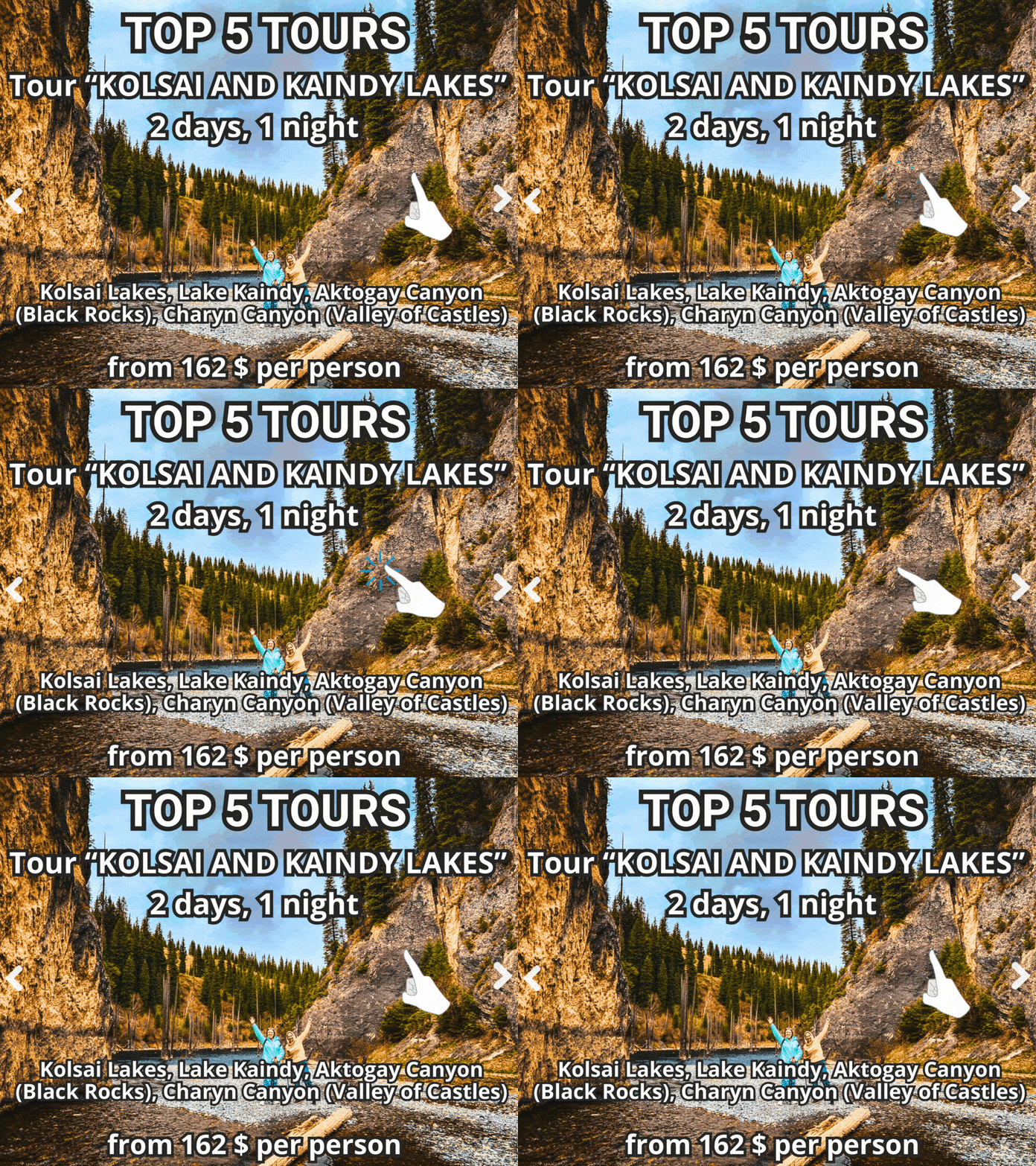
 Aktogay canyon translated from Kazakh means “White Stream”, despite the fact that the people call the canyon “Black Rocks”. The canyon is located directly on the bed of the Charyn River. Aktogay is truly the most majestic of the park's canyons, since the Charyn River receives many tributaries from the northern slope of the Terskey and Kungey Alatau ridges and, having become a full-flowing river, cuts through the eastern parts of the Zhalanash depression and the Toraigyr mountains with a grandiose canyon. Aktogay can be compared to the River Fish Canyon in Namibia, they are approximately identical in structure and age. Just think, people are ready to travel all over the world to see all the variety of canyons, and in Charyn Park there is an opportunity to see them all in just a couple of days.
 A place that includes all varieties of rocks and architectural images inherent in the Charyn Park is Bestamak Canyon. The word "Bestamak" from the Kazakh language is translated as "Five Isthmuses". The length of the main part of the canyon is 6 km, and along the entire length Bestamak changes its appearance several times: the classic Charyn views alternate with narrow passages - real stone sarcophagi. The colors of the rocks that formed the canyon range from pink to orange. The drying up river Bestamak comes to life only during the spring melting snow or after heavy rainfall. The main distinguishing feature of the sculptural fort of the Bestamak canyon is the abundance of various towers and clay rocks, reminiscent of the sculptures of Easter Island. In the canyon, thanks to a rare combination of geological factors, interesting fossils of extinct representatives of flora and fauna are found. Due to the location of the territory between the Kazakh and Dzungarian deserts, as well as due to the influence of the Northern Tien Shan mountain system, the presence of ecologically contrasting habitats for vegetation in the canyon is characterized by a high degree of biological diversity. There are seven types of vegetation here: steppe, desert, shrub, forest, riparian, meadow and marsh. Once in the Bestamak canyon, you begin to feel all the greatness of the earth's geological history. It is not for nothing that canyons always cause awe in a person before the work of nature, which personify eternity and movement.
 The last place on the list was taken by the Temirlik canyon, but not by accident, but because it usually closes the first day of the canyon tour and always gladly welcomes its guests for the night. In Temirlik canyon, thanks to the bright green dense thickets of tightness, a peculiar and very comfortable microclimate has formed: it is cool in the sultry heat in the canyon, and when a piercing cold wind blows throughout the park, it is warm in Temirlik. The canyon acquired its present appearance about a million years ago. Temirlik appears on the road very unexpectedly, it is difficult to notice him from afar. Before descending into the canyon, a panorama of a seemingly magical land opens up - in the sultry desert, overgrown with only rare shrubs, there is a heavenly place with red walls and a green carpet. Also, with the light hand of the scientist and writer P.I. Marikovsky, Temirlik canyon is now often called the Nightingale canyon. Their singing is the main symphony of this tract.
 So, the promised unique natural monument of republican significance is the Charyn ash forest dacha, or Ash grove. Sogdian ash is a relic, and in itself is a great rarity. In the world, such groves have survived only in two places - directly in the Charyn Park and in the Grand Canyon. The grove in the Charyn Park has been preserved since the Neogene period (25 million years). Ash grove is nothing more than the last islet of the relict forest that survived near the banks of the river under the natural protection of the walls of the Sarytogay canyon, since a peculiar climate has been preserved inside it since ancient times. The relict ash tree is the rarest representative of the flora of the globe that survived the Ice Age. Ash's vitality is so great that there are trees that are more than 700 years old. Due to the fact that the crown of the ash tree is raised high above the ground, and the leaves are long, pointed, they rarely sit on the branches, the sun's rays easily penetrate into the gaps between them. Therefore, all the foliage seems to be filled with light, and this transparency, together with the smooth light gray bark, gives rise to a feeling of radiance, brightness. That’s why ash is called «yasen’» in the most Slavic languages, which sounds like «bright».
In addition to ash trees, in the Sarytogay canyon, various-leaved turanga grows, which has a valuable physiological property - resistance to salinity and air dryness. A characteristic feature of the turanga is that the leaves vary greatly in shape and size - sometimes narrow and long, then ovoid or round, for which it got its name. The abundance of warmth, moisture and food attracts many birds to the grove, such as the black stork, tyvik, white-tailed eagle, Zhetysu pheasant, owl, scops owl and others. Some of these species are included in the Red Book of Rare and Endangered Birds of Kazakhstan. Among mammals, encounters with fox, ermine, steppe chorem, jungle cat, wild boar, muskrat, roe deer, tolai hare are possible.